|
||||||||
 |
||||||||
 |
||||||||
 |
 |
 |
 |
 |
 |
 |
 |
 |
 |
 |
 |
 |
 |
 |
 |
 |
 |

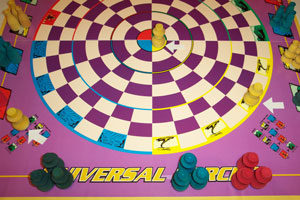
| UNIVERSAL FORCES™ “UNIVERSAL FORCES™” is a board game that requires players to achieve a common objective. The game may be played with two, three or four individual players or corresponding teams. The object of the game is to bring into play, playing pieces of the four various forces, (mountain, wind, water and fire) under each player’s or team's control, and to successively move those forces through to the center of the board and onto the safety of the home card. (This is the “Strength” reference guide located at each corner on the board.) The game involves the balancing of offensive and defensive scenarios in an attempt to control access to the board’s center sector. The unequally dominant power of the various forces leads to many interesting and multifaceted strategic situations. Control of various areas of play, as well as the opponents forces, may become the predominant focus for a winning player. This makes each play of the game, a unique experience and provides a multitude of variety and challenges. Players who are proficient with the game in its simplest configuration can increase the degree of difficulty by incorporating a multi-level playing surface found in the “masters edition”. 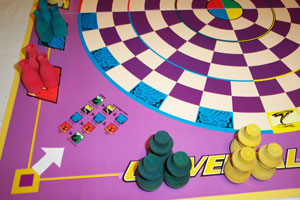 
THE FORCES Each player has a total of twelve (12) playing pieces, called forces,
identified by a unique, individualized shape, representing the player
or team and known as the “network”. These forces are
further delineated by color (green, yellow, blue and red) into a
power matrix based on their individual strengths. The four forces
are Mountains, Wind, Water and Fire, and their respective strengths
are 1) MOUNTAINS
are represented by green playing pieces, and symbolize the strength
of land. Wind and water cannot move mountains
except over a long period of time through erosion. Hence, mountains
are considered a stronger force than either wind
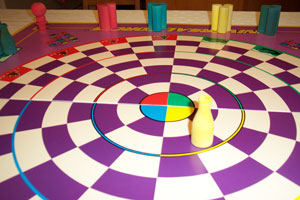
or water. The power of the forces is circular in nature, with no particular force being dominant over all others. This inherent vulnerability and balancing of power, leads to many interesting and dependant strategic situations, wherein, the strength of a particular force is dependant on its position in relation to other playing pieces on the board. THE BOARD There are two levels of play with “UNIVERSAL FORCES™”, basic and masters’ level. The layout of the game boards for both levels of play is identical. In the masters’ level of play, the inner two sectors of the game board may be raised resulting in further complications for players in achieving their objectives. This variant of the basic game is covered under the Masters’ Level Rules – Edition Two. The basic game board is comprised of three concentric sectors.
The outermost sector, of three (3) concentric rings with 32 sections
per ring, is the largest and has sixteen (16) colored sections in
its outside ring. These colored sections delineate the points upon
which the respective playing pieces first enter the field of play.
They are colored in accordance with the force they represent, and
at no time, can a force of a different power enter or rest upon
this space. The medial sector has three concentric rings with sixteen
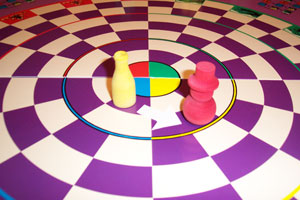
(16) sections per ring and no colored sections. The innermost sector
is comprised of three (3) concentric rings with its center point
of four (4) colored sections representing the four respective forces.
Any force can occupy any of the colored sections in the innermost
sector board. It is from these four sections, that the forces are
then able to move off the board, to the home disks. GENERAL MOVES A move occurs, when a player enters a force onto the playing area of an unoccupied section, the same color as the force. After that, a force can move to any unoccupied adjoining section, touching the section (including diagonally on the corners) it presently rests on. Players move one force at a time and only one section at a time. A force cannot be moved off the playing area (unless eliminated by an opponent) once it has entered the playing surface. A force cannot be placed on, or move back onto, a colored section in the outer sector that is not the same color as the force. It requires one move, for a player to take a force located on its respective colored section at the center of the board and to move it to the respective section and safety, of the home location. If all the forces of a player cannot make a move, i.e. all forces are pinned and/or, no others can enter the board through the outer sector, and providing that not all other players are in a similar situation, then the player’s turn is skipped. THE STACK Stacking is a defensive manoeuver, which a player may use to protect a force. In this move, a player’s force that is on an adjoining section to another of the players forces, can in a move, be placed atop the adjoining force. The result is two of the player’s forces resting on the same section, with the upper force being the one, which an opponent’s force must initially overcome. The maximum number of forces in a stack is two (2) and stacked forces cannot be moved together. The force atop the stack must be moved off as one turn, before the bottom force can be moved. Stacking is not permitted on any of the sections making up the inner sector, nor is it permitted on the colored sections of the outer ring. It is possible, to have an opponent’s force overcome and eliminate both forces in a stack, in a single move. It is also possible, for an opponent’s force to overcome the top force in a stack, and at the same time, pin the bottom force, in the same move.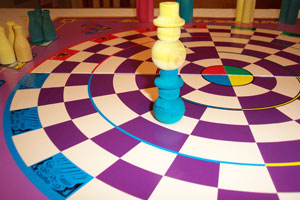 THE PIN A pin occurs, when a player’s force, on an adjoining section
to an opposing players force of the same strength, is moved atop
the opponent’s force. This move prevents the opponents force
on the bottom, from being moved until such time as the pinning force
has either been moved off of its own accord, or taken by an opposing
force. Pinning is not permitted in either the center sector, or
on the colored sections in the perimeter ring. 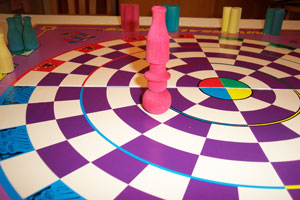 ELIMINATING OPPOSITION FORCES A player’s moving force, cannot take a pinned force directly,
if the player is also the pinning force. In this case, the player
must remove the pinning force as one move, and may possibly then
be in position, to take the opponent’s weaker force on the
next move. If a moving force, on an adjoining section, comes up against an opponent that is pinning another playing piece of the moving force’s network, then the moving force if stronger, can remove the opponent’s pinning force from the field of play and replace it atop the pinned force. The result is a pinned force being converted to a stack. If a moving force, is stronger than the top force of an opponent’s, two force stack, but weaker than the bottom force of the stack, the moving force and the opponents weaker top force are both removed from the playing field, leaving the opponent’s stronger bottom force intact. This strategic move is known as a sacrifice. 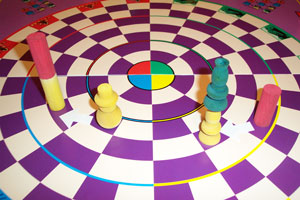 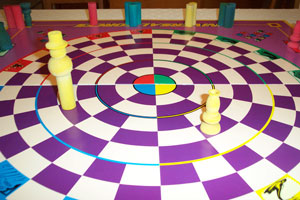 WINS and DRAWS 1) A win occurs, when a player achieves the objective
of getting one of each of their  |